

Hazard- Sea-Level Rise
Brisbane Airport: Cost-Effective Strategies for Sea-Level Rise Preparedness
Balancing Resilience and Cost-Effectiveness
Keywords
Brisbane Airport is an international airport serving Brisbane, the capital of the Australian state of Queensland. The airport is situated approximately 12 kilometers northeast of the Brisbane central business district, making it easily accessible for both domestic and international travelers.
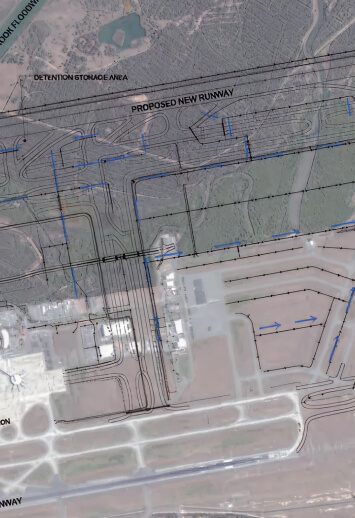
The airport covers an area of 2,700 hectares (6,700 acres), making it the largest in land area in all of Australia. It is in a region characterized by a subtropical climate, with hot, humid summers and mild, dry winters. This geographical context presents unique challenges and opportunities for airport operations, particularly in terms of climate resilience and infrastructure development.
Climate resilience study
Regarding climate resilience, Brisbane Airport Corporation (BAC) has proactively addressed the potential risks and impacts of climate change through the implementation of a comprehensive Climate Change Adaptation Plan. Recognizing the vital importance of airport infrastructure and its long-term operational life, BAC has focused on mitigating key climate-related risks such as sea-level rise, cyclonic events, droughts, extreme heat days, and warmer winters and summers. The plan includes detailed flood and drainage planning with Minimum Design Levels (MDLs) for new green-field developments, ensuring resilience against a 1 in 100-year cyclonic storm tidal surge event.
One of the flagship projects under this plan is the development of an Auto Mall, a multi-purpose auto retailing hub. Initially, the strict design regulations for flood threats led to high construction costs, making the project economically infeasible. However, BAC adopted a value engineering approach to balance cost and resilience, resulting in significant cost reductions and increased leasable area.
This case study highlights the measures taken by BAC to achieve a balance between resilience and cost-effectiveness, providing valuable insights for similar sectors and assets facing climate change challenges.
Brisbane Airport expects a sea-level rise of approximately 0.14m (0.09-0.18m) towards 2030 due to the consequences of climate change. BAC’s plan includes a detailed flood and drainage planning with MDLs for new developments. Strict design regulations for flood threats led to high construction costs, affecting the planning of the Auto Mall project. The initial estimated budget was 125 million Australian dollars, with filing and surcharging costs representing 60% of the total budget.
BAC adopted a value engineering approach to balance cost and value, reducing the design life of the project team from 100 years to 50 years, relocating flood conveyance drains, and installing flood/tidal gates. These measures significantly reduced the MDLs by 0.8m, resulting in a reduction of 400.000 cubic meters of fill and 1 million linear meters of wick drains.
The revised estimated project cost was reduced to 85 million Australian dollars, almost one third decrease from the original estimate. This also increased the leasable area by 1.5 hectares, restoring the project’s economic viability.