

Hazard- Snow and Icy Conditions
Munich Airport’s Winter Maintenance Plan during Snow and Icy Conditions
Airport deploys 184 vehicles and 600 personnel to clear 5.6 million square meters of snow and ice
Keywords
Munich Airport (MUC) is the second busiest airport in Germany, serving the city of Munich and the Upper Bavaria region. It serviced 41.6 million passengers in 2024, ensuring operational continuity around the clock during harsh weather conditions. The region is faced with the problem of ‘wet snow’ where the snow is less firm due to higher temperatures (around freezing point). Additionally, this is often accompanied by freezing rain, forcing the airport to suspend operations.
From early November to mid- April, the airport offers a dedicated winter maintenance service. A winter maintenance fleet comprising of 184 vehicles – 152 for clearing and deicing the airfield areas and 32 for roads, pathways and car parks on the landside. 71 tractors in this fleet are sourced from the surrounding local areas.
Further, 600 personnel are involved in implementing the winter service, including 520 persons coming from regional farming and haulage businesses. Over 200 workers are employed per shift to keep the airport clear of snow and ice. To maintain safe operations, it is key to clear the two runways, aprons and taxiways which span a total area of 5.6 million square meters. The runway (4km X 60 m) takes about 30 minutes to clear.
Evidence of the Solution(s) Effectiveness or Potential Impact
The airport employes specialized vehicles – 22 snow sweepers, 5 rotary snowplows and a snowcat during its winter maintenance. In addition to the newly purchased vehicles, the airport has also retrofitted farming tractors with snowplows to strengthen its service fleet. A dedicated winter maintenance team manages the winter services and is alerted by the Airport Operations division based on the weather and the condition of the movement areas. The division is supported by Germany’s National Meteorological Service and an early warning system for black ice which gathers information from 18 measuring stations.
Cleared snow masses are loaded on 6 snow depots accumulating a total of 2.2 million cubic meters each season. This is collected in an underground collection reservoir to ensure that the meltwater is not released into the environment. Additional measures are undertaken to ensure environmental protection from polluted surface run off. Surface deicers are only used when the movement areas are at risk of icing. Further, there are gutters on either side of the runways to catch runoff and carry the water into a meltwater retention basin. This is further conveyed to a treatment plant in a controlled manner. On some surfaces the de-icing flued is replaced with silica sand.
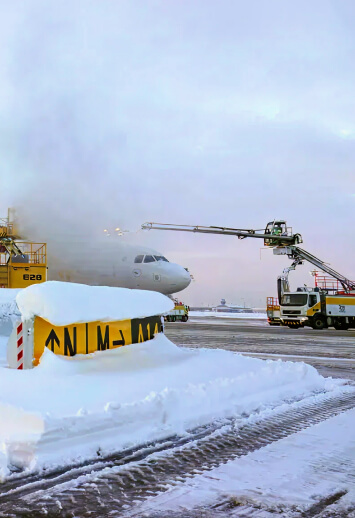
The aircrafts are de-iced by specialized teams called ‘polar bears’ provided by the Company for De-Icing and Aircraft Towing at Munich Airport Ltd. Specialized vehicles that spray the aircraft with de-icing fluid right before take-off. The system deices up to 15,000 aircrafts every year. The liquid is collected and recycled.
Enablers and Barriers
The airports strategy to temporarily engage equipment and personnel from the region enables it to expand its maintenance operations in the winter without the additional capex of purchasing new vehicles. Further, it also provides livelihood to the farmers in the winter season. This engagement model can be scaled by airports globally for development as well as resilience initiatives.
Further, the extreme winter weather can still cause delays and allied operational challenges. However, itis essential to maintain safety and address these impacts pre-emptively in the service plan.