
Report: Towards Resilient Public Finance in Nepal

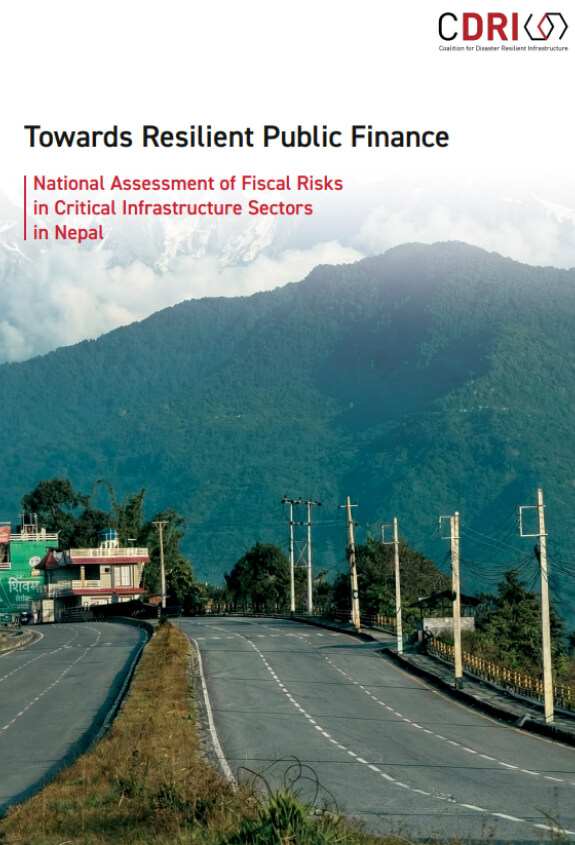
Towards Resilient Public Finance: National Assessment of Fiscal Risks in Critical Infrastructure Sectors in Nepal

Nepal faces recurrent fiscal risks from disasters due to its fragile Himalayan geography and climate vulnerability. Earthquakes, floods, and landslides repeatedly damage infrastructure, displace communities, and strain public finances. The 2015 Gorkha earthquake caused $71 billion in losses, while recent floods and quakes added hundreds of millions in reconstruction costs.

Annual average losses reach $325 million from earthquakes and $220 million from floods. Catastrophe modelling shows energy and transport sectors are most exposed, with landslides alone causing over $101 million annually. Current disaster funds, about $35 million nationally plus smaller reserves, fall far short of needs, even with the $150 million World Bank Cat DDO. Funding gaps persist, especially for high-severity events.

The report recommends layered risk financing, stronger reserves, resilient infrastructure investment, and improved sub-national data to safeguard fiscal stability and development progress.

Key points

Aishwarya Pillai

Lead Specialist

Alpana heads institutional partnerships, governance, and resource mobilization at CDRI, advancing cross-sector collaborations that drive resilient infrastructure programming across Member Countries and organizations. With over 25 years of experience spanning international development, global health, and the non-profit sector, she brings deep expertise in fundraising strategy, donor engagement, and delivering strategic change. 

At CDRI, Alpana has been pivotal in forging strategic alliances with governments, international organizations, and philanthropies. She also plays a key role in fortifying institutional systems and board governance mechanisms as the Coalition transitions into an international organization. 

Before joining CDRI, Alpana held senior leadership roles at The George Institute for Global Health, Plan India, WaterAid India, and SOS Children’s Villages, leading institutional fundraising and cultivating strategic partnerships for social impact. 

She holds a Master’s in Finance & Control from Aligarh Muslim University and completed Executive Education at Harvard Business School (CSR India). Her work is driven by a commitment to building enduring, values-based partnerships that accelerate sustainable development outcomes. 

Aishwarya Pillai

Alpana Saha

Director, Partnerships, Governance, and Resource Mobilisation 

Alpana heads institutional partnerships, governance, and resource mobilization at CDRI, advancing cross-sector collaborations that drive resilient infrastructure programming across Member Countries and organizations. With over 25 years of experience spanning international development, global health, and the non-profit sector, she brings deep expertise in fundraising strategy, donor engagement, and delivering strategic change. 

At CDRI, Alpana has been pivotal in forging strategic alliances with governments, international organizations, and philanthropies. She also plays a key role in fortifying institutional systems and board governance mechanisms as the Coalition transitions into an international organization. 

Before joining CDRI, Alpana held senior leadership roles at The George Institute for Global Health, Plan India, WaterAid India, and SOS Children’s Villages, leading institutional fundraising and cultivating strategic partnerships for social impact. 

She holds a Master’s in Finance & Control from Aligarh Muslim University and completed Executive Education at Harvard Business School (CSR India). Her work is driven by a commitment to building enduring, values-based partnerships that accelerate sustainable development outcomes. 

Agathe Nougaret –