
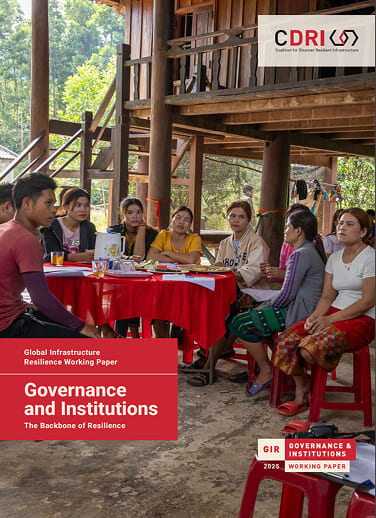
Global Infrastructure Resilience Report 2025 Working Paper: Governance and Institutions: The Backbone of Resilience

This GIR working paper finds that infrastructure resilience is fundamentally a governance challenge, not merely a technical one. Reliable services depend on coordinated institutions, clear mandates, risk-informed planning, resilient financing, updated codes and standards, strong regulatory oversight, and sustained stakeholder engagement.

Case studies show that countries achieving stronger resilience integrate disaster and climate risks into investment decisions, asset management, emergency preparedness, and recovery. The paper recommends mainstreaming resilience across infrastructure agencies through dedicated leadership, accountability, budgets, and performance systems. Governments should strengthen coordination among finance, planning, disaster management, regulators, local authorities, private operators, communities, academia, and professional associations.

Priorities include modernizing codes, enforcing standards, expanding capacity building, improving hazard data systems, addressing cascading risks across sectors, embedding resilience in public investment frameworks, and using institutional assessments to identify gaps, guide reforms, and build long-term adaptive capacity .

Key points

Aishwarya Pillai

Lead Specialist

Alpana heads institutional partnerships, governance, and resource mobilization at CDRI, advancing cross-sector collaborations that drive resilient infrastructure programming across Member Countries and organizations. With over 25 years of experience spanning international development, global health, and the non-profit sector, she brings deep expertise in fundraising strategy, donor engagement, and delivering strategic change. 

At CDRI, Alpana has been pivotal in forging strategic alliances with governments, international organizations, and philanthropies. She also plays a key role in fortifying institutional systems and board governance mechanisms as the Coalition transitions into an international organization. 

Before joining CDRI, Alpana held senior leadership roles at The George Institute for Global Health, Plan India, WaterAid India, and SOS Children’s Villages, leading institutional fundraising and cultivating strategic partnerships for social impact. 

She holds a Master’s in Finance & Control from Aligarh Muslim University and completed Executive Education at Harvard Business School (CSR India). Her work is driven by a commitment to building enduring, values-based partnerships that accelerate sustainable development outcomes. 

Aishwarya Pillai

Alpana Saha

Director, Partnerships, Governance, and Resource Mobilisation 

Alpana heads institutional partnerships, governance, and resource mobilization at CDRI, advancing cross-sector collaborations that drive resilient infrastructure programming across Member Countries and organizations. With over 25 years of experience spanning international development, global health, and the non-profit sector, she brings deep expertise in fundraising strategy, donor engagement, and delivering strategic change. 

At CDRI, Alpana has been pivotal in forging strategic alliances with governments, international organizations, and philanthropies. She also plays a key role in fortifying institutional systems and board governance mechanisms as the Coalition transitions into an international organization. 

Before joining CDRI, Alpana held senior leadership roles at The George Institute for Global Health, Plan India, WaterAid India, and SOS Children’s Villages, leading institutional fundraising and cultivating strategic partnerships for social impact. 

She holds a Master’s in Finance & Control from Aligarh Muslim University and completed Executive Education at Harvard Business School (CSR India). Her work is driven by a commitment to building enduring, values-based partnerships that accelerate sustainable development outcomes. 

Agathe Nougaret –