
Hazard- Snow and Icy Conditions
Navigating Permafrost: Icing Conditions and Safety Measures at Iqaluit Airport
Adapting to Harsh Weather: Iqaluit Airport’s Approach
Keywords
Iqaluit Airport (IATA: YFB, ICAO: CYFB) is the main airport serving Iqaluit, the capital of Nunavut, Canada. Located adjacent to the city, the airport plays a crucial role in connecting the remote region with the rest of Canada and beyond. YFB saw a significant increase in passenger traffic in 2024, handling approximately 150,000 passengers.
Iqaluit International Airport is extremely important to communities in Nunavut given the region’s lack of road access. When the airport was constructed in 1942, little was known aboutthe underlying permafrost and its importance to the safety and viability of airport operations. However, many problems related to permafrost – including runway stability issues stemming from thaw settlement of ice-rich soils – have occurred at the airport over its lifespan. Along with the need for expansion and facility replacement, permafrost issues prompted the development of an improvement plan by public and private partners.
Permafrost is permanently frozen ground found in polar regions which forms the stable ground for arctic airports. However, with rising temperatures the frost is beginning to thaw leading to differential settlement and ground deformations. This can pose a safety hazard to airport operations.
In 2013-2014, the Iqaluit International Airport Improvement Project was initiated; by then, the importance of understanding the nature, location and influence of permafrost degradation on infrastructure was well-understood. Research projects were undertaken, employing a variety of techniques – including ground-penetrating radar, permafrost core analysis, surficial mapping, and remote sensing – to generate site-specific knowledge about permafrost properties and model interactions among permafrost, climate, and airport infrastructure (both existing and proposed). A key finding of this work is that permafrost tends to be subject to greater warming under pavement than embankments (and other “naturalized” surfaces).
The data collected has been used to inform infrastructure decision-making. Maps were produced to identify potentially problematic locations for existing and proposed infrastructure (e.g., thaw-sensitive soils and/ or difficult terrain for construction).
Measures
- A taxiway was relocated with an insulated barrier to reduce permafrost damage. Further, the importance of removing thick snow cover in key areas was recognized.
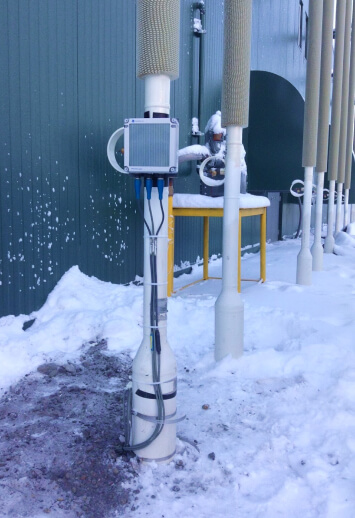
- The construction of the new terminal and services building there was a concern regarding the permafrost thaw underneath. The construction project installed passive thermosyphons which circulate cool air and maintain the frozen state of the ground. To monitor the effectiveness of the syphons a comprehensive temperature monitoring solution was implemented. Digital temperature cables with multiple sensors were
installed horizontally adjacent to the thermosyphons and vertically into the ground. The system was connected to a cloud platform where real time data was accessible and allowed engineers, contractors and the airport authority to monitor the performance of the thermosyphons remotely. - Drainage was improved to reduce the infiltration of surface water into permafrost.Overall, informed engineering and operational decisions have been made at the airport with respect to the integrity of the underlying permafrost. Real time monitoring was found to be essential along with collaboration with multiple stakeholders to ensure timely action is taken. The initiatives help the airport protect its infrastructure in the long-term.