

Hazard- Rise in Groundwater Level
Groundwater flooding at Heathrow Airport
Annual Snow Plan to outline resources and procedures
Keywords
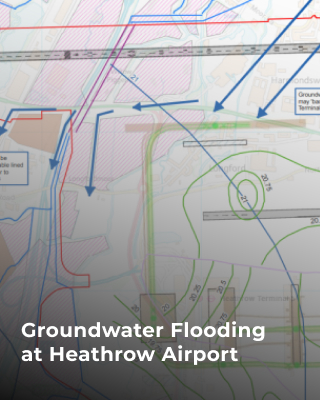
Heathrow Airport is located between river Colne and river Crane, their several streams and groundwater bodies. Construction of impermeable surfaces like foundations, columns, tunnels etc can cause the ground water to rise locally. In low lying areas of the airport the groundwater levels are close to the surface as the surrounding area is underlain by saturated gravel deposits. Further, additional factors like heavy rainfall events and fluvial flooding can cause the groundwater to rise significantly.
As per the climate risk assessment, in the short term there is an increased likelihood for extreme rainfall events which overwhelm the drainage infrastructure and groundwater flooding. In the long-term the risk of surface and groundwater flooding remains high as well.
Increase or decrease in groundwater levels can affect asset integrity. It could cause subsidence or water ingress damage to buildings and surfaces as well as leaks in tunnels and basements. This can cause premature degradation and subsequently pose risk to operations. Groundwater flooding can also pose a risk to utilities placed in basements.
At Heathrow, the Operational Flood Plan defines the early warning for groundwater as the Clockhouse Lane pit > 13.7 m AOD. New buildings are designed to address water ingress / flooding risk. The Operational Flood Plan manages the impact of flooding on critical assets with measures ranging from increased monitoring and inspections, flood barriers and use of pumping equipment. Further, underground structures and basements have procedures for groundwater ingress removal and damage prevention. Critical assets are placed on platforms to safeguard them from the floodwater.
As a short-term action, the 2021 Climate Change Adaptation Report highlights a stress test of the airport drainage model to identify critical thresholds and existing response measures to manage surface water and groundwater events. This can lead to correlation with capital investments to reduce the likelihood of critical thresholds being exceeded.
For the construction of Terminal 5 on the former Perry Oaks site an impermeable clay curtain was installed to separate the site from the gravel aquifer. The groundwater contours are seen to be discontinuous across this curtain. Given the location of the airport, a flood risk assessment is conducted for every new proposed construction in the planning phase. This assessment proposes mitigation measures to be employed during construction like dewatering of foundations or use of coffer dams, and during operations like facilitate the flow of water around impermeable barriers and ensuring natural discharge pathways into existing river channels are maintained.