
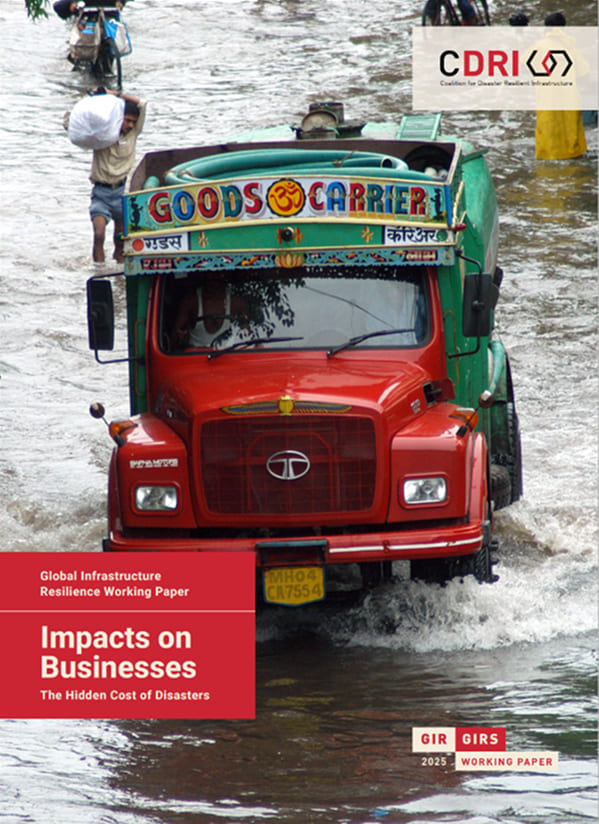
Global Infrastructure Resilience Report 2025 Working Paper: Impact on Businesses: The Hidden Cost of Disasters

The GIR 2025 working paper examines how climate-related hazards and disasters affect businesses, infrastructure operators, and SMEs worldwide.

Based on a survey of more than 500 organizations across 50+ countries, it finds that disasters are increasing in frequency and economic impact, causing operational disruptions, supply chain failures, and financial losses. While many large businesses and infrastructure companies have continuity and risk management plans, significant gaps remain in testing, implementation, funding, insurance coverage, and crisis response. SMEs are particularly vulnerable due to limited access to finance, technology, insurance, and technical expertise.

The report emphasizes that resilience must be embedded across the entire business and infrastructure lifecycle through stronger governance, technology adoption, risk-informed financing, policy support, and capacity building. It calls for coordinated action by governments, businesses, financiers, and value-chain partners to strengthen resilience and reduce future losses.

Key points

Aishwarya Pillai

Lead Specialist

Alpana heads institutional partnerships, governance, and resource mobilization at CDRI, advancing cross-sector collaborations that drive resilient infrastructure programming across Member Countries and organizations. With over 25 years of experience spanning international development, global health, and the non-profit sector, she brings deep expertise in fundraising strategy, donor engagement, and delivering strategic change. 

At CDRI, Alpana has been pivotal in forging strategic alliances with governments, international organizations, and philanthropies. She also plays a key role in fortifying institutional systems and board governance mechanisms as the Coalition transitions into an international organization. 

Before joining CDRI, Alpana held senior leadership roles at The George Institute for Global Health, Plan India, WaterAid India, and SOS Children’s Villages, leading institutional fundraising and cultivating strategic partnerships for social impact. 

She holds a Master’s in Finance & Control from Aligarh Muslim University and completed Executive Education at Harvard Business School (CSR India). Her work is driven by a commitment to building enduring, values-based partnerships that accelerate sustainable development outcomes. 

Aishwarya Pillai

Alpana Saha

Director, Partnerships, Governance, and Resource Mobilisation 

Alpana heads institutional partnerships, governance, and resource mobilization at CDRI, advancing cross-sector collaborations that drive resilient infrastructure programming across Member Countries and organizations. With over 25 years of experience spanning international development, global health, and the non-profit sector, she brings deep expertise in fundraising strategy, donor engagement, and delivering strategic change. 

At CDRI, Alpana has been pivotal in forging strategic alliances with governments, international organizations, and philanthropies. She also plays a key role in fortifying institutional systems and board governance mechanisms as the Coalition transitions into an international organization. 

Before joining CDRI, Alpana held senior leadership roles at The George Institute for Global Health, Plan India, WaterAid India, and SOS Children’s Villages, leading institutional fundraising and cultivating strategic partnerships for social impact. 

She holds a Master’s in Finance & Control from Aligarh Muslim University and completed Executive Education at Harvard Business School (CSR India). Her work is driven by a commitment to building enduring, values-based partnerships that accelerate sustainable development outcomes. 

Agathe Nougaret –