
Los Angeles Airport (USA)

Hazard- Wildfires

Los Angeles International Airport combats annual wildfires

Adapting Infrastructure to Meet Seismic Challenges

Keywords

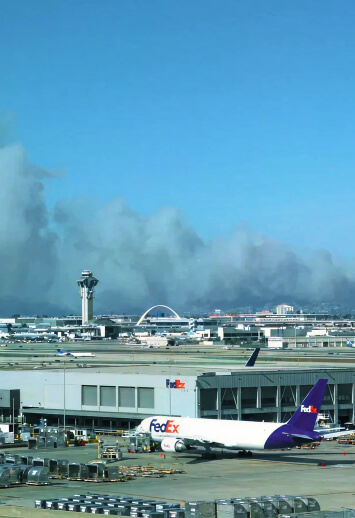
Los Angeles International Airport (LAX) is a hub airport in Los Angeles, California. A hub airport for many airlines has 9 passenger terminals with a traffic of 76.6 million passengers in 2024. Given its location LAX is prone to seasonal wildfires due to increasing drought conditions and the Santa Ana and Diablo winds, which exacerbate the fires.

Given their scale, wildfires can damage infrastructure and cause loss of life. While the fires have not impacted LAX infrastructure till date, operational challenges due to poor air quality, smoke and reduced visibility continue to impact the airport.
In response, LAX deploys some infrastructural and operational measures to safeguard its operations from the fires:

  • Fire-resistant Landscaping: LAX uses plants that are less likely to catch fire and maintains zones clear of vegetation near critical infrastructure.
  • Enhanced Fire Detection Systems: The airport has installed advanced fire detection systems including thermal imaging cameras and smoke detectors to identify and respond to fire.
  • Infrastructure Protection: Protective measures, such as firebreaks and barriers, are in place to shield critical infrastructure from wildfires. These measures help to prevent the spread of fire to airport facilities.
  • Flight Diversions and Ground Delays: Airports like LAX and Hollywood Burbank Airport often divert flights and implement ground delays to manage air traffic and avoid areas affected by smoke and firefighting operations.
  • Travel Waivers: Airlines issue travel waivers during wildfire events, allowing passengers to reschedule flights without incurring change fees.
  • Coordination with Firefighting Efforts: Airports coordinate closely with firefighting agencies to ensure the safety of both air and ground operations. This includes managing airspace to allow firefighting aircraft to operate effectively.
  • Passenger Advisories: Airports and airlines provide regular updates and advisories to passengers about potential delays and disruptions caused by wildfires.
  • Air Quality Monitoring: Some airports monitor air quality and may adjust operations based on air quality index readings to ensure the safety of passengers and staff.

These measures help ensure the safety of passengers and minimize disruptions to air travel during wildfire events.

References

Aishwarya Pillai

Lead Specialist

Alpana heads institutional partnerships, governance, and resource mobilization at CDRI, advancing cross-sector collaborations that drive resilient infrastructure programming across Member Countries and organizations. With over 25 years of experience spanning international development, global health, and the non-profit sector, she brings deep expertise in fundraising strategy, donor engagement, and delivering strategic change. 

At CDRI, Alpana has been pivotal in forging strategic alliances with governments, international organizations, and philanthropies. She also plays a key role in fortifying institutional systems and board governance mechanisms as the Coalition transitions into an international organization. 

Before joining CDRI, Alpana held senior leadership roles at The George Institute for Global Health, Plan India, WaterAid India, and SOS Children’s Villages, leading institutional fundraising and cultivating strategic partnerships for social impact. 

She holds a Master’s in Finance & Control from Aligarh Muslim University and completed Executive Education at Harvard Business School (CSR India). Her work is driven by a commitment to building enduring, values-based partnerships that accelerate sustainable development outcomes. 

Aishwarya Pillai

Alpana Saha

Director, Partnerships, Governance, and Resource Mobilisation 

Alpana heads institutional partnerships, governance, and resource mobilization at CDRI, advancing cross-sector collaborations that drive resilient infrastructure programming across Member Countries and organizations. With over 25 years of experience spanning international development, global health, and the non-profit sector, she brings deep expertise in fundraising strategy, donor engagement, and delivering strategic change. 

At CDRI, Alpana has been pivotal in forging strategic alliances with governments, international organizations, and philanthropies. She also plays a key role in fortifying institutional systems and board governance mechanisms as the Coalition transitions into an international organization. 

Before joining CDRI, Alpana held senior leadership roles at The George Institute for Global Health, Plan India, WaterAid India, and SOS Children’s Villages, leading institutional fundraising and cultivating strategic partnerships for social impact. 

She holds a Master’s in Finance & Control from Aligarh Muslim University and completed Executive Education at Harvard Business School (CSR India). Her work is driven by a commitment to building enduring, values-based partnerships that accelerate sustainable development outcomes. 

Agathe Nougaret –