

Hazard- Pluvial Flooding
Schiphol’s Innovative Water Management Against Pluvial Floods
Schiphol’s Water Vision 2030 study
Keywords
Amsterdam Airport Schiphol (AMS) is the primary airport of the Netherlands, with 66.8 million annual passengers (2023), making it one of the major hubs within Europe. Due to its geographical location, Schiphol plays a pivotal role for transfer passengers to the United States, Asia and South America.
But, when zooming into the exact location of the airport, Schiphol is situated more than four meters below sea level. Schiphol is surrounded by a very complex urban area and built on reclaimed land in the Haarlemmermeerpolder.
Hence with climate change, leading to more extreme rainfall, hail and thunderstorms, the airport anticipates significant impact on its infrastructure and operations. Due to the increasing weather variability, Schiphol must be prepared for more frequent disruptions in scheduled flight operations and routes, which could lead to a loss of €25 million when having no air transport for one day.
Measures
Schiphol’s Water Vision 2030 outlines a comprehensive climate adaptation strategy, including flood protection measures, sustainable airport operations and adaptive airport city planning. Key learnings from this case include the importance of integrating climate resilience into airport planning and operations, as well as the need for collaboration between various stakeholders to achieve long-term climate goals. It specifies a set of five incremental key actions to enhance climate resiliency, also known as the Climate Resilient Airports (CRA) framework.
The five key actions outlined in Schiphol’s Water Vision 2030 are:
- Flood protection: Addressing sea-level rise and extreme rainfall.
- Dealing with weather extremes: Managing increased intensity of storms, changing precipitation,
- temperature changes, and changing icing conditions.
- Achieving good water quality: Ensuring a healthy ecosystem despite desertification and
- changes in biodiversity.
- Adaptive airport city planning: Enhancing airport use and passenger convenience.
- Greening airport operations: Implementing sustainable solutions and innovations to improve local climate and energy management.
Specific adaptive measures of Schiphol against pluvial floods are:
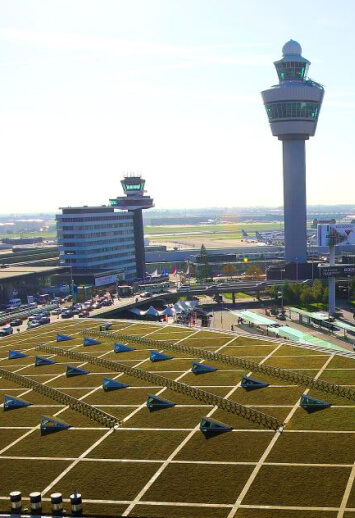
- Green roofs: These special roofs act as sponges, ensuring that water is drained gradually.
- Innovative water storage: Schiphol has developed a smart water storage solution at the Uplatform, working together with the regional water board. Three interconnected water systems have been installed below and next to the platform to manage rainwater drainage. There are three ways to store water innovatively: Lane gutter, WAVIN infiltration boxes and AquaBase
- New standards for drainage: Schiphol has established new standards for drainage based on a special hydraulic model developed to calculate various climate scenarios. This helps to manage the increased intensity of storms and heavy rainfall
- Water-permeable surfacing: Schiphol uses water-permeable surfacing to manage water runoff and prevent flooding.
Evidence of the Solution(s) Effectiveness or Potential Impact
Schiphol Airport’s climate adaptation strategy began with the presentation of the Water Vision 2030 in 2015, which set out the ambition to cope with climate change risks through airport planning and water management activities up to 2030 and beyond. In 2017, Schiphol conducted a comprehensive pluvial stress test, which illustrated the frequency and extent of pluvial flood risk and translated potential damages and operational disruptions into direct and indirect costs. Following this assessment, Schiphol’s management team decided on a T100 (extreme rainfall event close to once per 100 year) pluvial flood adaptation pathway and initiated the Flood Resilient Schiphol program.
Schiphol Airport has effectively managed flood risk, making it one of the safest polders in the Netherlands with only minor interventions needed to further enhance flood safety. In the event of flooding elsewhere in the country, Schiphol could serve as a ‘safe haven’ or ‘air bridge’ to safer areas.