
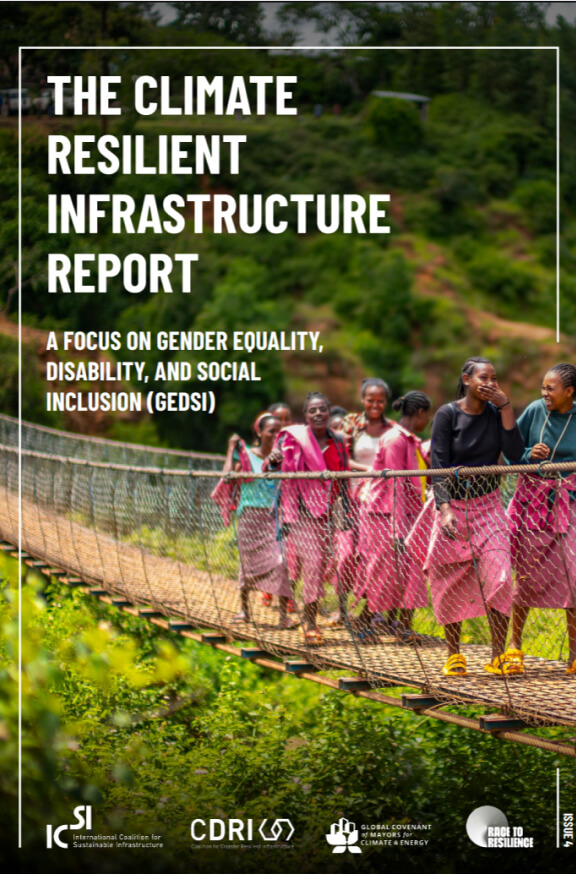


Ce rapport, rédigé par la Coalition internationale pour des infrastructures durables (ICSI), la Coalition pour des infrastructures résilientes aux catastrophes (CDRI) et le Pacte mondial des maires pour le climat et l'énergie (GCoM), met l'accent sur l'intégration de l'inclusivité tout au long du cycle de vie des infrastructures afin de lutter contre les risques climatiques et les inégalités sociales. Il s'aligne sur les cadres mondiaux tels que les ODD, l'Accord de Paris et le Cadre de Sendai, en préconisant des politiques, des normes de conception et des opérations qui donnent la priorité aux groupes vulnérables.
Le rapport présente plus de 40 études de cas dans le monde entier, notamment la modernisation d'hôpitaux à Kiribati, la reconstruction d'écoles inclusives au Népal et des ponts sur les pistes au Rwanda, démontrant comment l'intégration de l'initiative GEDSI améliore la résilience, l'accès et l'équité.
Les stratégies clés comprennent la planification participative, la conception universelle, la budgétisation sensible au genre et les audits d'accessibilité. En intégrant l'initiative GEDSI, les infrastructures peuvent réduire la vulnérabilité, accélérer le redressement et favoriser le développement durable. Ces initiatives ont déjà renforcé la résilience de plus de 36 millions de personnes dans le monde, ce qui prouve qu'une infrastructure inclusive et intelligente face au climat est essentielle pour une adaptation équitable et une résilience à long terme.
Le saviez-vous ?
- Les infrastructures résilientes au changement climatique doivent intégrer les questions de genre, de handicap et d'inclusion sociale.
- La conception inclusive réduit la vulnérabilité et accélère le rétablissement après les chocs climatiques.
- L'approche du cycle de vie intègre la GEDSI dans les phases de planification, d'approvisionnement et d'exploitation.
- La planification participative garantit que des voix diverses façonnent des solutions d'infrastructure résilientes.
- Plus de quarante études de cas mondiales démontrent des stratégies d'intégration GEDSI évolutives.
- Les initiatives ont renforcé la résilience de plus de trente-six millions de personnes.