
Hazard- Sea-Level Rise
Oakland International Airport: A Dike to Protect from Rising Sea-Levels
A Dutch Invention to Protect an American Airport
Keywords
Oakland International Airport, located on the coast of Northern California, is a major airport with two
terminals, four runways, and significant general aviation activity, serving approximately 11 million
passengers in 2024. The airport’s proximity to sea level has already influenced decision-making in
several areas.
Climate hazards
California’s seismic activity poses earthquake-related risks to the airport, such as seismically induced liquefaction of sediment. Additionally, FEMA standards and accreditation relevant to the robustness of dikes apply to the perimeter dike at the airport. Although flooding has not occurred, there has been some seepage at the dike, creating wetlands. The development of “Runway Safety Areas” may require filling in these wetlands. These diverse regulatory drivers necessitate technical reviews by planners and engineers. In recent years, the broader region has been concerned about sea level rise due to climate change, prompting the airport’s planners and engineers to focus on potential risks from this climate change-related effect.
One influential project in securing attention to adaptation and resilience planning is Adapting to Rising Tides (ART), sponsored by the San Francisco Bay Conservation and Development Commission and the National Oceanic and Atmospheric Administration. Conducted at the sub-regional level, its goal is to provide future scenarios and develop strategies for reducing and managing risks from projected climate change impacts. Oakland International Airport staff credits this effort with raising awareness on the subject. As part of the inventorying of sub-regional assets, ART stakeholders select asset categories, choose metrics to characterize the assets, and use these metrics to assess existing conditions and stressors. Sector-specific metrics were developed in many areas, including airports.
The airport’s staff had been reviewing the perimeter dike and other infrastructure for several reasons. Although they viewed sea level rise as a minor risk relative to others, it was decided to incorporate sea level rise into design requirements for the perimeter dike because it was feasible to do so. Given that sea level models do not provide definitive information on projected sea level rise, a rough average of modeling results was determined. The result for the perimeter dike’s design was a 1 ft increase in height and the ability to receive additional load in the future. This decision was made within a broader planning context that addressed seismic and FEMA standards related to the perimeter dike. A budget earmark for this work is awaiting final approval.
Airport perimeter dike project
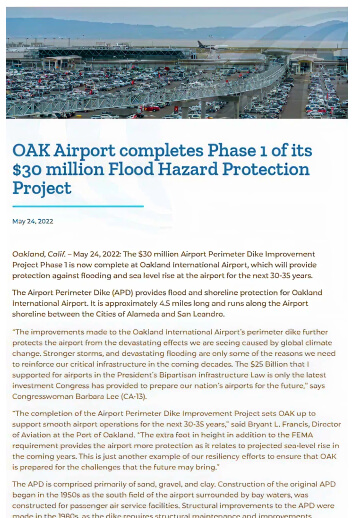
Oakland International Airport has completed Phase 1 of its $30 million Airport Perimeter Dike Improvement Project. This project aims to provide protection against flooding and sea level rise for the next 30-35 years. The Airport Perimeter Dike (APD) is approximately 4.5 miles long and runs along the airport shoreline between the cities of Alameda and San Leandro. The improvements made to the dike include enhancing its stability and raising its height by an additional foot above the FEMA requirementto account for projected sea level rise due to global warming.
The project was partially funded by two grants from the State of California under its Local Levee Assistance Program, totaling $6.4 million, with the remainder self-funded by the Port of Oakland. Construction began in early 2020 and took approximately two years to complete. The APD is primarily composed of sand, gravel, and clay, and requires structural maintenance and improvements approximately every 30 years.
The completion of Phase 1 sets Oakland International Airport up to support smooth operations for the next 30-35 years, providing more protection against stronger storms and devastating flooding caused by global climate change. The project is part of broader resiliency efforts to ensure the airport is prepared for future challenges.
Climate change impacts can be considered in the preparation of design requirements, and in some cases, there is less needed to wait for absolute rigor and precision in the technical information supporting them. Participation in broader climate adaptation planning efforts can cultivate this thinking. Airport planners also benefited from having modeling of projected climate impacts already available, allowing them to think and act within a set of given parameters.