


Hazard – Sea-Level Rise
Regional collaboration to address Sea-Level Rise for San Diego
International Airport
Vulnerability assessment for sea level rise flood scenarios
Keywords
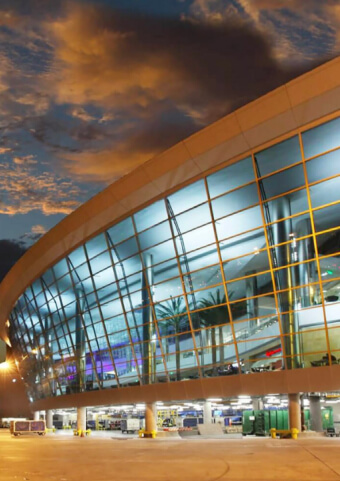
Located in the southwest corner of Southern California, San Diego International Airport (SAN) is the third busiest passenger airport in California, serving approximately 25 million passengers in 2024. The single-runway airport is situated on 661 acres near downtown San Diego on the north end of San Diego Bay, just above sea level. The San Diego County Regional Airport Authority plans and operates the airport.
In 2010, ICLEI (Local Governments for Sustainability) joined forces with the Tijuana National Estuarine Research Reserve and the San Diego Foundation to develop a sea level rise adaptation strategy for San Diego Bay. The project focused on sea level rise, the most prominent climate threat, and involved a steering committee with representatives from the San Diego County Regional Airport Authority. The project developed a series of milestones and deliverables, including a vulnerability assessment for 2050 and 2100 to sea level rise for 13 sectors such as potable water, stormwater, and wastewater utilities.
In the vulnerability assessment methodology, existing and future conditions in relation to the following three adaptation planning factors are analyzed:
- Exposure: Determination whether the whole system or parts of the system will experience a specific changing climate condition.
- Sensitivity: Degree to which a system would be impaired by the impacts of climate change.
- Adaptive capacity: Ability to adjust or changes to the system to maintain its primary functions.
Evidence
The case study relied in ICLEIs adaptation model, involving leadership commitment and five milestones:
- Conduct a vulnerability study
- Set preparedness goals
- Develop preparedness plan
- Implement preparedness plan
- Measure progress and evaluate plan
The findings from the study indicated that there are risks to regional airport operations, especially in 2100. For the year 2050, the output of the model showed that the airport will not be flooded from the shoreline. However, according to the airport itself, flooding is not necessarily a problem for the airport but more for the surrounding key roads like San Diego Road and Harbor Drive and other airport facilities at the other side of the bay. Therefore, for new projects or airport buildings, the airport executes a sea-level rise impact study. One conclusion of such a study could be that buildings are more elevated to be prone for a rising sea-level. Also, the airport, in collaboration with the Port of San Diego and the City of San Diego, installed sensors in the bay to have constant data available on the sea-level developments.
The regional initiative significantly heightened awareness about the critical climate change impact of sea level rise across the San Diego Bay area. Leveraging the ICLEI model and its resources enabled the region to commence the project at an advanced stage and progress to more sophisticated strategies. This approach effectively communicated the extent of the airport’s risk to both the public and decision-makers, highlighting that while shoreline inundation is unlikely, stormwater issues may necessitate future investments. Additionally, the inclusion of representatives from the San Diego County Regional Airport Authority on the steering committee helped articulate the airport’s interests in regional activities and facilitated the integration of findings and potential next steps into their organizational framework.