

Hazard- Fog/Haze
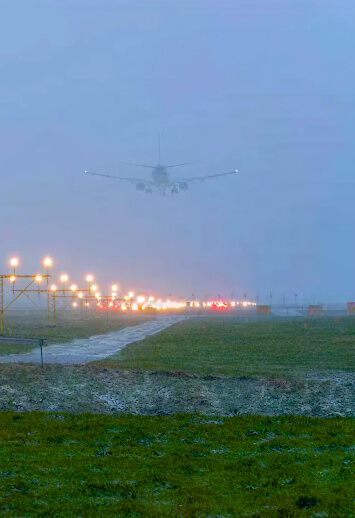
Foggy Conditions at Schiphol Airport
Low Visibility Procedures to ensure safety
Keywords
Amsterdam Airport Schiphol (AMS) is the primary airport of the Netherlands, with 66.8 million annual passengers (2023) making it one of the major hubs within Europe. Due to its geographical location, Schiphol plays a pivotal role for transfer passengers to the United States, as well as for Asia.
A few times a year, Schiphol faces significant mist and foggy conditions which impact their operations. Clouds can sometimes pose problems regarding landings. This is because the runways and flight paths are less visible to pilots and air traffic controllers. Due to reduced visibility, the airport can face delays and cancellations of flights. Therefore, Schiphol introduced a protocol to minimize the disruptions caused by foggy conditions.
Reduced visibility occurs when air traffic controllers and pilots can see less than five kilometers into the distance, a measurement known as Runway Visual Range (RVR). Additionally, reduced visibility is noted when the cloud base is less than 300 meters (1000 feet) above the ground, resulting in low-hanging clouds. If visibility drops below 1500 meters and the cloud base is lower than 100 meters (300 feet), pilots and air traffic controllers lose sufficient sight of the runways and taxiways. In such conditions, Low Visibility Procedures (LVP) are implemented to ensure safety.
Measures
Low Visibility Procedures (LVP) are divided into four phases: A, B, C, and D, with D representing the worst visibility conditions. In LVP A, visibility is less than 1.5 kilometers and the cloud base is between 60 and 100 meters. In LVP B, visibility of runways in use is less than 550 meters and the cloud base is lower than 60 meters. In LVP C, visibility of the runway is less than 350 meters. In LVP D, visibility of the runway is less than 200 meters.
During times of poor visibility, there is a risk of aircraft collision due to air traffic control not being able to see them. When it’s foggy or when there are low-hanging clouds, only runways that are independent of each other can be deployed to minimize the risk of planes colliding. During peak landing times, it is crucial to reduce the chance of crossing traffic at the two runways in the event of a go-around, which is why parallel runways such as the Polderbaan and Zwanenburgbaan or the Zwanenburgbaan and Aalsmeerbaan are used. Similarly, during peak take-off times, it is important to minimize the chance of aircraft crossing each other in the air, so aircraft take off from runways facing opposing directions during peak periods and low visibility conditions, often utilizing the Buitenveldertbaan runway. In the worst visibility conditions, known as LVP D, there are no take-off or landing peaks, and the airport adopts 1+1 runway use, such as the Kaagbaan runway and Polderbaan runway.
Also, runways are secured with stop bars at the entrances and exits, aircraft fly further apart, runway use is adjusted, works on airport grounds are limited or halted, and traffic controllers actively guide pilots when taxiing at the airport. Thanks to tools like the Instrument Landing System (ILS), aircraft can continue to land even when visibility is reduced.