

Hazard- Snow and Icy Conditions
Alaska Airports Dealing with Extreme Cold and Snow
Keywords
Alaska is home to several major airports, including Ted Stevens Anchorage International Airport and Fairbanks International Airport. Ted Stevens Anchorage International Airport handles approximately 3.4 million passenger enplanements annually, while Fairbanks International Airport serves 516,761 passengers. These airports are in the northernmost state of the United States, characterized by its wilderness, rugged terrain, and extreme weather conditions. Situated at high latitudes, Alaska’s airports face unique challenges such as severe cold, heavy snowfall, and permafrost, which impact their operations and infrastructure. Despite these challenges, they play a crucial role in connecting remote communities and supporting the state’s economy.
Challenges
Alaska is responsible for maintaining aviation facilities in over 200 villages that lack road access, relying on aircraft and alternatives for essential services. Severe flooding and erosion, exacerbated by glacier melt and decreasing sea ice, have caused structural damage to airstrips and airport access roads. Flooding can also restrict access to the airports. Response measures include reinforcing or elevating runways and access roads and relocating facilities. Despite these efforts, academic research indicates that climate change risks in Alaska’s transportation sector are not systematically addressed.
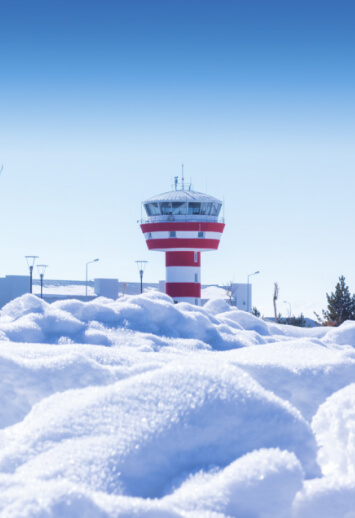
Alaska’s major airports, such as Ted Stevens Anchorage International Airport and Fairbanks International Airport, face challenges due to extreme cold and snow. Winter weather conditions lead to operational disruptions, requiring constant maintenance and deicing operations. Extreme cold affects aircraft and ground equipment performance, while thawing permafrost compromises infrastructure integrity. Measures to address these challenges include hydraulic modelling studies, environmental impact assessments, and contingency planning for drainage and flood protection.
Investments
Several villages in Alaska have taken action to address the challenges posed by climate change, with the support of various agencies. During the years 2002-2003, the FAA Airport Improvement Program (AIP) provided a $300,000 grant for the Master Plan for the viallge of Kaktovik and $10,000,000 for a Master Plan for the village of Koyukuk to elevate its runway out of the 100-year flood plain. The Government Accountability Office (GAO) reported on the circumstances facing the villages and outlined the funding, coordination, and prioritization needed to address their needs. However, the Federal Emergency Management Agency (FEMA) and FAA have supported the reinforcement of aviation facilities in some villages and provided planning funds for potential relocations.
The AIP-funded project in Koyukuk, completed in 2006, protected the newly elevated runway from flooding that same year. Relocating villages is a slow and expensive process, with new rural Alaska airports costing $15 to $20 million and taking 3 to 5 years, sometimes up to 10 years, due to the building methods required in these locations. Many entities have been involved in managing this long-term issue as transparently and efficiently as possible, including a special oversight subcommittee in the U.S. Senate. In 2007, Alaska incorporated the villages’ concerns about erosion and flooding into its Climate Change Task Force work.
The University of Alaska developed a method for prioritizing adaptation measures for the state’s transportation network. Significant challenges remain for coordinating and funding the larger issue of village erosion. Alaska now has a public infrastructure climate adaptation strategy, and the Alaska Department of Transportation and Public Facilities keeps the climate risk to village airports on its agenda. The state has developed an adaptable statewide aviation system plan guided by the FAA Airport System Planning Process (ASPP), which identifies needed airport improvements, sets funding priorities, proposes aviation policy, and documents the existing system with photos, maps, and data.Studies characterizing the economic significance of rural Alaska airports contribute to cost-benefit analyses.