

Hazard- Pluvial Flooding
Pluvial Flood mitigation at Munich Airport
Water course rerouting and hydraulic modelling for protection against heavy rainfall and pluvial flooding
Keywords
Munich Airport (MUC) is the second busiest airport in Germany, serving the city of Munich and the Upper Bavaria region. It serviced 41.6 million passengers in 2024, ensuring operational continuity around the clock during harsh weather conditions.
The airport is surrounded by the Isar river and many smaller streams flowing southwest to northeast of the site. The construction of the airport required rerouting many streams and ditches in the Erdinger Moos running west to east. The streams running south to north were connected to a southern catchwater drain. Via the airport the water is routed through a south-north connection to a northern diversion channel which distributes the water into existing ditches. The airport also operates a telecontrol system to monitor the water discharge into the natural watercourses.
The alternate water courses were designed ecologically as a part of the nature conservation measures. Structures like winding river courses, shallower spots and deeper pools, fast-flowing areas and calm bays along with suitable shrubs and trees to protect the banks and prevent substances to enter the water.
The flood protection measures undertaken during rerouting the watercourses ensure that the airport is protected against a 1 in 100-year event with a climate allowance of 15%. However, to respond to the extremely rare and intense rainfall and flood events, the airport follows a 3 pillar approach. While the approach is iterative, the airport is currently executing step 1 and 2.
Hazard Analysis
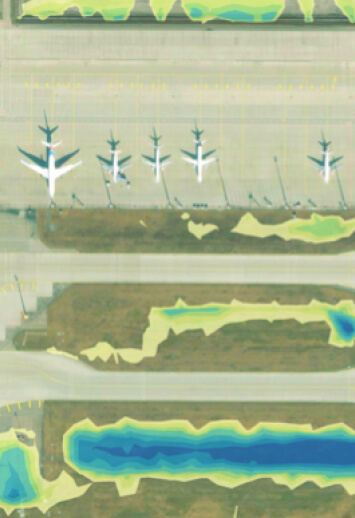
The airport commissioned a multi-phase study based on the Integral Concept for Municipal Flash Flood Risk Management of the Bavarian State Ministry of the Environment an Consumer Protection. A 2D surface model was developed for the airport grounds, the surrounding watercourses and their catchment areas. The model reconstructs the airport and its surrounding areas as a digital terrain model. It also calculates the sewer water levels, discharges and overflow volumes. The outcomes visualize the flood depths, flow directions and velocities, presenting hazard maps with exact hazard zones on the airport site.
Risk Analysis
Step 2 analyses the hazard zones to highlight the risks to operations and infrastructure. The risk is then communicated to the multiple stakeholders through tools such as checklists, animations and leaflets. The information collected through this collaborative process is used in combination with the analysis to prioritize vulnerable areas.
Measures
The third step aims to plan and implement preventive operational, organizational and infrastructural measures. These respond to the prioritized vulnerabilities identified in the risk analysis. Operational measures such as regular maintenance and cleaning of the drainage system as well as the establishment of emergency plans have been employed. One of the proactive measures being taken is the creation and implementation of a robust drainage system. By adding greenery to surfaces and roofs, initial runoff peaks are reduced, evaporation is promoted, and the local microclimate is enhanced. Where possible, clean rainwater is collected and returned to the groundwater through decentralized infiltration systems, thus maintaining the natural water cycle.
Evidence of the solution(s) effectiveness or potential impact
The hazard analysis was carried out in 3 phases.
Phase 1 (2019) :
- A flood protection review was carried out and concluded that the airports water system was able to discharge a 1 in 1,000 year flood event. Hence extensive flooding is not expected at the airport.
Phase 2 (2022):
- To evaluate the drainage performance, the surface model was expanded to include the sewer network calculation. This revealed that localized flooding due to surface runoff and back waters from the sewer system can be expected.
Phase 3 (2023 onwards) :
- Conceptual measures are being developed to minimize infrastructural
damage and ensure operational performance. Technical Services department monitors the
performance of the existing sewer system and ensures that sufficient retention space is available in
events of surface flooding.
Enablers and Barriers
There is increasing recognition of the importance of flood calculations to protect airport infrastructure and operations from heavy rainfall. Hydraulic modeling is the most effective method for assessing the impacts of such events. This process relies on comprehensive and accurate data to produce realistic and reliable results. Evaluating these results requires significant expertise, and effective communication is crucial. Findings must be presented clearly and logically. Munich airport makes efforts to awareness and develop solutions for heavy rainfall preparedness include using videos and checklists to engage stakeholders.