


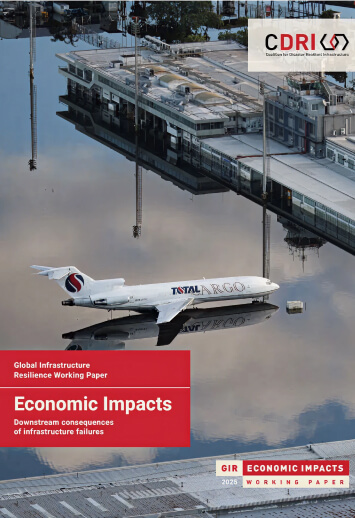

Ce document de travail GIR 2025 met en évidence la façon dont les catastrophes affectent les économies bien au-delà des dommages directs causés aux biens. Lorsque les services d'infrastructure tels que l'eau, l'électricité et les transports tombent en panne pendant de longues périodes, les effets d'entraînement perturbent les entreprises, les moyens de subsistance et les services publics essentiels.
En utilisant le modèle mondial des risques liés aux infrastructures et l'indice de résilience (GIRI) en conjonction avec le modèle de l'économie verte (GEM), l'étude révèle que les coûts indirects sont, en moyenne, 7,4 fois plus élevés que les dommages directs, atteignant jusqu'à 16 fois plus dans certains pays. Entre 2025 et 2050, les défaillances des infrastructures pourraient réduire la croissance du PIB de 5,2% par an, les pertes s'élevant à 7,4% d'ici à 2050, voire plus dans les pays vulnérables comme le Bangladesh et les Philippines.
Il est essentiel que la reconstruction rapide réduise les impacts de manière significative - une reprise de 10 ans réduit les pertes de PIB à 3%, tandis qu'une reprise de 4 ans les réduit à 2,27%. Les investissements dans la résilience et la préparation produisent des dividendes économiques substantiels.
Le saviez-vous ?
- Les conséquences économiques vont au-delà des dommages directs causés aux infrastructures par les catastrophes.
- La reconstruction rapide réduit considérablement les pertes de PIB et les perturbations économiques.
- Les coûts indirects sont en moyenne 7,4 fois plus élevés que les coûts directs des dommages aux infrastructures.
- Les défaillances des infrastructures peuvent entraîner des pertes de PIB allant jusqu'à 14,5 %.
- Les investissements proactifs dans la résilience permettent de réaliser des économies substantielles à long terme à l'échelle mondiale.
- Les retards dans la reprise aggravent les pertes, ralentissent la croissance et réduisent les investissements futurs.